The ceiling stain appeared three weeks ago. It was the size of a quarter. You figured it would dry. Now it is the size of a dinner plate and the drywall feels spongy when you press it. Or maybe it is not a stain at all — maybe it is a smell. A faint mustiness in the hallway that comes and goes. Or paint that started bubbling along the baseboard in a room that has no reason to be wet.
Here is what is happening: water is moving through your walls or ceiling right now, and it has been doing it long enough to leave visible clues. The damage you can see is almost never the full picture. Behind that stain is wet drywall, possibly saturated insulation, and wood framing that has been absorbing moisture for days or weeks. Mold may already be growing on surfaces you cannot reach without opening the wall.
Hidden water damage is the most expensive kind — not because the repairs are inherently complex, but because people wait. They wait because the problem does not look that bad from the outside. By the time they act, the damage has spread far beyond that original little stain, and what could have been a targeted repair becomes a room-wide remediation project.
Water is relentless and patient. It follows gravity, seeps along the top edge of wall plates, wicks through drywall paper, and migrates along plumbing lines and electrical conduits that create pathways through your wall cavities. A leak on the second floor can show up as a stain on the first-floor ceiling twenty feet away from the actual source.
Drywall is the biggest enabler of hidden damage. Standard half-inch drywall can wick moisture twelve to twenty-four inches above the waterline through capillary action. The paper facing on drywall is also one of mold's favorite food sources. So the very material that hides the leak from your eyes is also feeding the mold that grows in the dark behind it.
In many Oklahoma City, OK homes, wall cavities also contain fiberglass batt insulation. Fiberglass does not absorb water the way a sponge does, but it traps moisture against the surfaces it touches — studs, sheathing, drywall — and dramatically slows natural drying. A wall cavity with wet insulation can stay damp for months even after the leak has stopped, creating a long-term mold incubator you never see.
Older Oklahoma City, OK homes with plaster-and-lath walls present a different challenge. Plaster is denser than drywall and holds moisture longer, but it does not show stains as readily. A plaster wall can be wet for weeks before any visible sign appears on the surface. By that point, the wood lath behind it may be colonized with mold growth.
Tearing open every wall that might be wet is one approach. It is also expensive, destructive, and often unnecessary. We use non-invasive detection technology to map hidden moisture before making a single cut.
Infrared thermal imaging cameras detect temperature differences on surfaces. Wet areas inside a wall cool through evaporation, creating a thermal signature that is invisible to the eye but clearly visible on an infrared scan. Our technicians walk the perimeter of the suspected area with the camera and identify exactly where moisture is present behind the finished surface.
Non-invasive moisture meters use radio frequency signals to detect elevated moisture content in materials without penetrating the surface. We scan walls, ceilings, and floors to establish the boundary of the wet zone with precision. Where we need a more exact reading — especially in structural framing — we use pin-type meters inserted through small probe holes that are easily patched later.
Combining these tools creates what we call a moisture map: a documented layout of exactly where the water has traveled, how far it has spread, and which materials are affected. This map drives every decision that follows. We only open walls where the map says moisture is present, and we only remove materials that cannot be dried in place. In Oklahoma City, OK, that targeted approach saves homeowners thousands of dollars compared to a gut-and-replace strategy.
Once we know where the water is and where it has been, we fix the source first. No amount of drying or demolition matters if the leak is still running. Sometimes the source is obvious — a cracked supply line fitting, a corroded drain connection. Other times, especially with slow leaks in Oklahoma City, OK homes, we need to run pressure tests on plumbing lines or inspect roof penetrations and flashing to find the entry point.
After the source is repaired, we open the wall only in the areas our moisture map identified. Wet drywall beyond salvage gets cut out. Saturated insulation gets removed. If mold is present on the framing — and after weeks of hidden moisture, it often is — we treat it with antimicrobial solutions and use HEPA air scrubbers to capture spores.
Then we set up targeted drying. Air movers directed into the open wall cavities, combined with dehumidifiers pulling moisture from the air, dry the exposed framing and sheathing to target levels. We take daily moisture readings at multiple points until every piece of wood in the affected zone is below the acceptable threshold.
Only after the structure is confirmed dry do we clear the area for reconstruction. Rebuilding on top of wet framing is a mistake that guarantees mold will return within months.
You have a stain, a smell, or a soft spot that is bothering you? Do not wait for it to grow. Call (833) 541-0100 and let us map what is happening behind that wall before it gets worse.
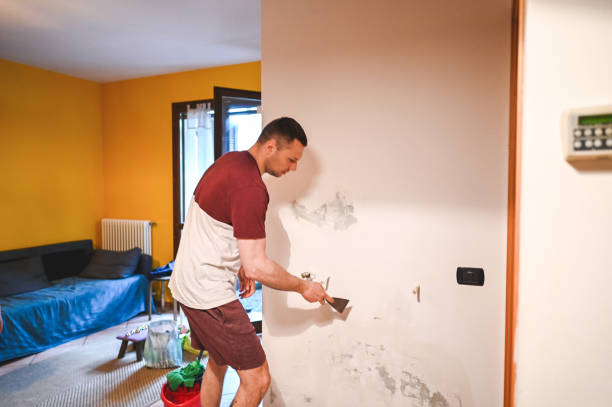
Every day you look at that ceiling stain or catch a whiff of that musty smell and think "I should really get that checked," the moisture behind your walls is spreading a little further. The mold colony is getting a little bigger. The repair is getting a little more expensive.
Stop guessing and start knowing. Call (833) 541-0100 today and we will bring our thermal imaging and moisture detection equipment to your Oklahoma City, OK home, find out exactly what is going on behind those walls, and give you a clear path forward. The peace of mind alone is worth the call.
"After a month of musty smells in my closet without visible cause, the detection team used infrared cameras to find a hidden wet zone behind the wall in minutes. A shower valve pinhole leak was the culprit. They coordinated the plumbing repair, treated early mold on the studs, and dried the area in four days. Waiting longer would have been disastrous; I am so glad I called them here in Oklahoma City, OK."
"After noticing bubbling paint, the crew used moisture mapping to trace a leak from our dining room back to a bathroom supply line two rooms away. They targeted only the affected wall, treated the framing, and dried it in six days. Their ability to find the source and limit demolition was outstanding."
"A slow kitchen ceiling stain grew for two months. A roofer found nothing, but these guys used thermal imaging to trace it to an upstairs drain leak ten feet away. They opened the ceiling, removed wet materials, treated the early mold, and dried it all in record time. Six months later, it is still perfect. Best money we have spent on this Oklahoma City, OK house."
Oklahoma City (/oʊkləˌhoʊmə -/ i), officially the City of Oklahoma City, and often shortened to OKC, is the capital and largest city of the U.S. state of Oklahoma. The county seat of Oklahoma County, it ranks 20th among United States cities in population, and is the 8th largest city in the Southern United States. The population grew following the 2010 census and reached 681,054 in the 2020 census. The Oklahoma City metropolitan area had a population of 1,396,445, and the Oklahoma City–Shawnee Combined Statistical Area had a population of 1,469,124, making it Oklahoma's largest municipality and metropolitan area by population.
Zip Codes in Oklahoma City, OK that we also serve: 73099 73119 73118 73114 73117 73116 73111 73110 73112 73020 73173 73012 73013 74857 73142 73141 73145 73149 73160 73078 73104 73139 73132 73131 73135 73134 73008 73097 73084 73102 73162 73054 73151 73150 73159 73064 73108 73109 73106 73107 73105 73103 73179 73170 73049 73169 73165 73127 73120 73121 73122 73128 73129 73101 73113 73124 73125 73126 73136 73137 73143 73144 73146 73147 73148 73152 73154 73155 73157 73163 73164 73167 73172 73178 73184 73189 73190 73194 73195